
Not long ago, Brenda Sanford was told she might never walk again.
It happened quickly—a serious infection, surgery, months in hospital—and somewhere along the way she heard words no one is prepared to hear: ‘don’t expect too much.’
 But Brenda had spent a lifetime caring for others—as a nurse, a caregiver to her husband, and later to her mother. She understood hardship. She understood perseverance, and in the quiet space between what she was told and what she believed, she made a decision.
“I had a talk with myself,” she says. “I’m going to walk again.”
When Brenda arrived at The Village at St. Clair in early 2025, she was just beginning to take steps with a walker. The physical challenge was significant, but the mental hurdle was just as real.
“You have to admit you need help,” she says. “That’s a big step.”
In those early days, when progress was measured in inches, Anna came into her life.
A Program for Active Living coordinator, Anna believes her role goes far beyond mobility.
“Sometimes you just click with someone,” she says. “Brenda is like my grandma. We’ve built a real friendship.”
Together, alongside physiotherapists and students, they focused on small, consistent efforts, and Brenda always showed up.
“She worked incredibly hard,” Anna says. “Five days a week. Sometimes more. Even on weekends.”
What Anna saw was something essential to recovery: belief.
“You can support someone physically,” she says, “but that determination has to come from them. Brenda has that. She’s crushed every challenge.”
Brenda keeps it simpler.
“Small steps,” she says. “Pick one thing you can’t quite do. Work at it. Then move to the next.”
Over time, those small steps added up.
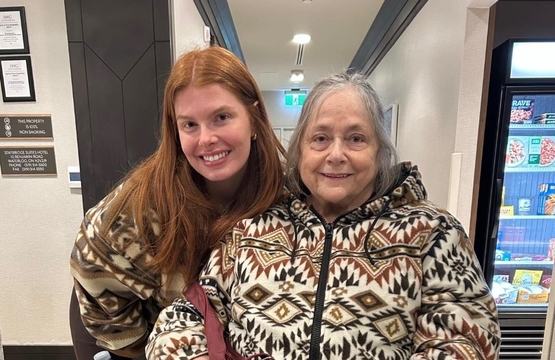 Today, Brenda walks to and from the dining room with confidence using her four-wheeled walker and she’s far from finished.
“I’m really happy with what I’ve done in a year,” she says. “But I’m not done.”
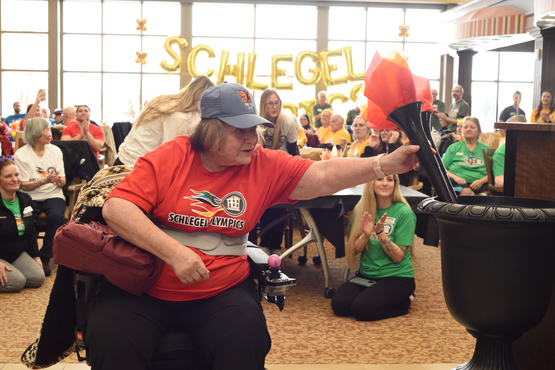
That determination carried her to the Schlegel Olympics in early 2026—something that would have felt impossible a year earlier.
“It was just fun,” she says, smiling. “To get out, to feel normal for 24 hours. We had a riot.”
For Anna, watching Brenda in that moment was overwhelming.
“I was announcing participants,” she recalls. “When I said Brenda’s name… I almost lost it.”
It’s a feeling that speaks to something deeper than care.
“In other settings, you might see someone for a moment,” Anna says. “Here, you build real relationships. You see them every day. You get to know who they are.”
For Brenda, that connection has made all the difference.
“We just clicked,” she says. “That matters.”
There are still goals ahead—maybe a cane one day, for example, but both Brenda and Anna stay grounded in what’s in front of them.
“One step at a time.”
Because in the end, this story isn’t just about how far Brenda has come. It’s about the decision to keep going and the people who walk alongside you.


