
It’s a beautiful September morning under clear blue skies as residents and team members from four Schlegel Villages arrive at the Mohawk Village Memorial Park in Brantford for an afternoon of cultural exchange with neighbours from The Six Nations of the Grand River.
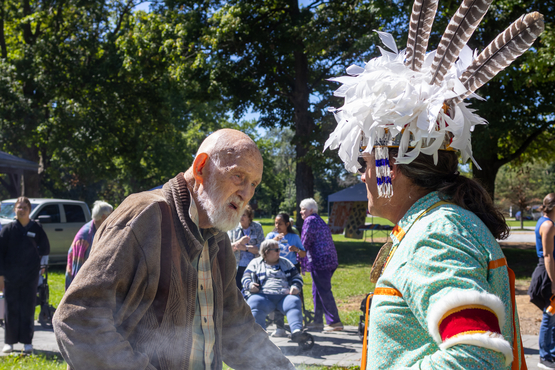 This is the continuation of a friendship that began in the fall of 2025, when a day to celebrate the Wisdom of the Elder brought members of several First Nations together with Schlegel Villages to learn about the history of the residential school system in Canada.
In the shadow of the Mohawk Institute Residential School – the imposing brick structure upon the hill, which overlooks the park and was the first such school to begin the dark history of cultural assimilation in Canada – friends gather again to honour the spirit of shared learning and understanding.
The greeting to open the circle is offered by Hayden, the seven-year-old grandson of Sherlene Bomberry who says he’s proud to be learning Cayuga, the critically endangered language of his ancestors, nearly lost through more than a century of residential school tragedy and the impacts of The Indian Act.
Hayden later explains what the greeting means to him and what is intended when people gather to share and learn.
“You tell the earth that you are here and you are putting your minds together,” he explains, his age betrayed by remarkable poise and thoughtful articulation. “You are bringing one mind all together. What we do is we give thanks for what we have. May it remain in our minds that we thank the earth in our special ways.”
On this day, there are several speakers connected to both The Six Nations of the Grand River and Schlegel Villages. Among them are Linda Comley and her husband Art from The Village of Wentworth Heights in Hamilton, who as physicians spent time decades ago in Haida Gwaii off the Pacific coast supporting communities there. There they saw the effects of the residential school system and the neglect suffered by First Nations communities at the hands of the federal government, for they were often the ones fighting “Indian Affairs” for the treatments needed to help the communities they served.
Art and Linda share some of that perspective, as well as their deep gratitude for the newfound friendship this day represents. “My admiration for the resilience and perseverance of our First Nations people has only grown over time,” Linda says, gesturing out to the beautiful park surrounding the group, “and I applaud you for the efforts you’ve undertaken to maintain your traditions.”
 Dawn Hill, the secretary and treasurer of the committee working to develop the space, spoke to the group about what the park represents and how it helps residential school survivors reclaim some of their traditions.
“This park opens everything up,” she explains. “You are free to walk around; it should not be a confined space and everyone is welcome.”
She and her siblings were forced into the school they called “The Mush Hole” in the late 1950s, among the indigenous children across Canada who were taken “in order to change them and take away their identity.” The pain of that past now lives beside what is a peaceful place, she says.
“I don’t want hostility, I don’t want anger; we’ve lived through all that,” she added.
“This park is a place of peace, and it is for everyone.”
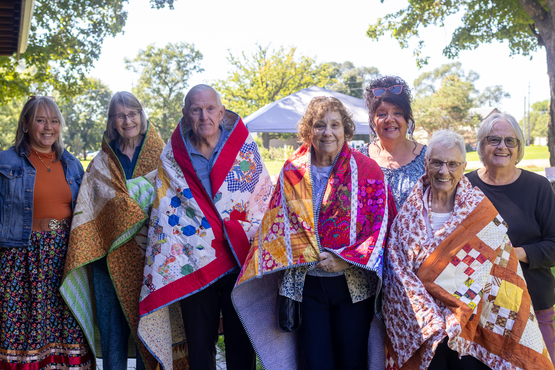
After a shared meal and an opportunity to learn about traditions associated with a sacred fire, where dreams, hopes and pain can be placed and carried to the creators above, each Village is gifted a beautiful quilt. These quilts come from the idea that no child should ever have been taken from their home and their loved ones to live in the cold of a harsh, unknown world. The founder of Quilts for Survivors, Vanessa Genier of Timmins, explains in the write-up that accompanies the generous gifts, that each quilt is created for survivors to help ease their journey and bring them some small comfort. Indeed, the quilts were gifted to the Villages in the spirit of friendship and as an extension of safety and comfort.
“I believe that a quilt is love sewn together to bring people together,” Vanessa writes, and for this reason, the gift feels appropriate. As friends from The Six Nations of the Grand wrap the quilts around the people of Schlegel Villages on a sunny September afternoon, the sentiment of a 7-year-old’s greeting – the coming together as one mind – could not be any clearer.


