
Doug Grove has spent a lifetime finding ways to be useful to the people around him.
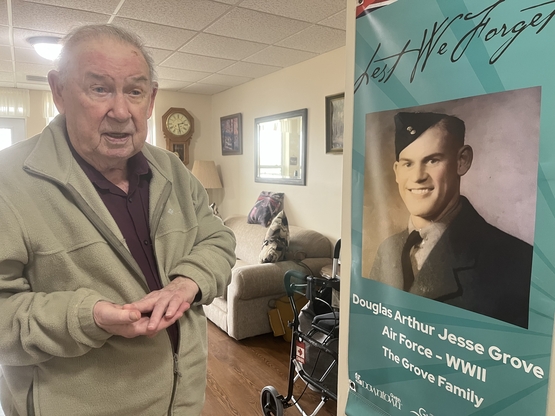 Born and raised in Guelph, he lived in the same home for nearly six decades. It was the kind of neighbourhood he remembers clearly – full of young families, schools within walking distance, and a small shopping plaza just five minutes away. Even after a stroke in his mid-30s left him legally blind, and later reliant on hearing aids, Doug stayed. He raised his children there, learning, as he puts it, to be “a Mr. Mom,” adapting to whatever life required of him.
What never changed was his connection to community or his belief that everyone has something to contribute.
“I didn’t have time to get in trouble,” he jokes, reflecting on decades of volunteer work across Guelph.
For 25 years, Doug was a fixture at the River Run Centre, volunteering for more than 900 shows. He couldn’t take tickets – his eyesight made that difficult – but he found other ways to help, ushering guests, guiding school groups to their seats, and making sure every chair in the theatre was filled. It was work that mattered, even if it happened quietly.
“I couldn’t be ticket taker… but I could usher,” he says simply.
That same mindset carried into other parts of his life. He volunteered with the Guelph Museum for 25 years, served on the Guelph Accessibility Committee & Barrier Free Committees, contributed to Transit & Guelph General Hospital boards, and spent nearly two decades as president of the local Canadian Council of the Blind. His contributions weren’t defined by his limitations, but by his willingness to show up.
In Doug’s mind, community has always been about participation, not perfection.
That philosophy followed him when it came time to leave his longtime home. After years of managing on his own, even routine tasks like laundry and yard work became increasingly difficult. Moving into an apartment didn’t make sense to him; it would simply shift the burden without removing it.
Instead, he chose The Village of Arbour Trails.
“I can always stay in this building, and can stay in Guelph,” he says. That continuity mattered. So did the assurance that, as his needs changed, he wouldn’t have to uproot his life all over again.
But if Doug’s address has changed, his sense of community has not.
Today, his contributions look different, but they are no less intentional. He creates and shares light-hearted fact sheets to be shared in the Village, helping to spread a bit of joy and lots of smiles. He builds relationships with neighbours, forming new friendships in a place where many arrive after leaving long-held homes of their own.
“I’ve gained more friends,” he says.
It’s a simple statement, but one that reflects a deeper understanding: community doesn’t disappear when life changes – it evolves.
Doug still thinks often about the neighbourhood he left behind, where every house once had children and familiar faces lined the street, but he doesn’t dwell on what’s gone. Instead, he recognizes something familiar in his new surrounding – a network of people, each with their own stories, each finding their way.
“Now I don’t have to do it alone,” he says.
That, more than anything, speaks to his philosophy.
For Doug, community isn’t just about where you live. It’s about how you live with others and how you contribute, adapt, and remain present, even when circumstances shift. It’s about understanding that everyone, regardless of ability, has something to offer.


