
When considering data and documentation in the health of residents at Schlegel Villages, numbers are more than just statistics – they tell a story about opportunities to make life better.
This was the case for the team in Long-Term Care at The Village of Riverside Glen in Guelph an increase in continence-related skin infections on one neighbourhood came to light.
Throughout the final months of 2025, IPAC Lead Kayla Killby and ADNCs Raman Aujla and Vincent Domosmog, who supports continence care and skin health, began noticing a concerning trend toward increasing skin infections in one particular neighbourhood, notably infections related to moisture and continence care
Rather than simply accepting the numbers, they began to ask questions.
“We didn’t want to just accept that this was our number for the month,” Raman says. “We wanted to look into what was causing it.”
The team focused on the neighbourhood with the highest number of infections and began observing care practices, spending time alongside team members to better understand what was happening.
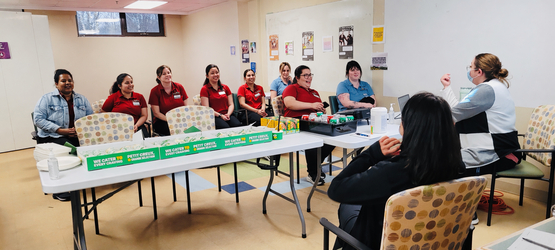 “We wanted to see if there were learning gaps, if the process wasn’t clear, or if there was something else contributing,” Raman explains.
The team initially wondered if newer team members might need additional support. However, through their observations, they discovered something they didn’t expect.
“We thought maybe it was newer team members, but it was actually the opposite,” says Raman. “The newer graduates knew the process very well. It was some experienced team members who needed a refresher.”
The team also recognized they needed a new approach to education, so rather than relying on traditional group sessions, they focused on walking alongside neighbourhood team members one-on-one.
Using a mannequin and simulated care environment, team members were asked to demonstrate their usual approach. This allowed the team to see where additional support was needed and provide education in the moment.
“We had done group education in the past, but people don’t always ask questions or engage,” says Raman. “We thought, let’s do one-on-one education. Show us how you do the care, and then we can provide education based on what we see.”
The team also reviewed the care process itself, identifying opportunities to improve consistency and ensure team members had the right tools and knowledge to support resident skin health.
“Looking beyond the numbers allows us to see opportunities, not just trends,” says Kim Arquette, Schlegel Villages’ Director of Clinical Support who supports all Villages in skin health, wound care and continence. “Every village is on their own journey of continuous improvement and through collaboration, shared learning and understanding the gaps, we continue to strengthen care and enhance outcomes for every resident.”
A key part of the improvement at Riverside Glen was using data to create awareness and a sense of ownership among the team members. Kayla created a visual graph showing the neighbourhood’s infection rates compared with others across the Village, and seeing the difference helped team members understand where they could improve.
“When they saw the graph, they were shocked,” says Raman. “They could see where their neighbourhood stood compared to the others.”
When they saw where they could improve, the results were significant.
The neighbourhood recorded 15 skin infections in December 2025 and eight in January 2026. Following the February education sessions and process improvements, the numbers dropped substantially, to the point where in June, there was only one infection of note.
The team’s success was celebrated, reinforcing the importance of recognizing improvement and building pride.
“We didn’t want to just identify what wasn’t being done well,” says Raman. “We wanted to celebrate their success.”
Maintaining that success has required ongoing attention. Neighbourhood leaders continue to use audit tools to observe practices, provide feedback, and ensure the improvements remain part of everyday care.
“When we started the new process, we had to go back and audit to make sure it was being followed,” says Raman. “At first, it wasn’t 100 percent, so we provided more education. Then it became consistent.”
For the Riverside Glen team, this process highlighted the fact that collaboration is critical in pursuing ongoing quality improvement and any facet of Village Life.
“Collaboration is key,” says Vincent Domosmog, who is covering for Kayla as IPAC lead while she’s on maternity leave. “IPAC, skin care, continence care, personal care — everyone has a role. We all rely on each other.”
Their advice to others facing similar challenges is simple: don’t let the numbers become just numbers.
“Try to look into what’s causing that number,” says Raman. “Collaborate, find the root cause, and work together on a solution.”
At Riverside Glen, one neighbourhood’s challenge became an opportunity to demonstrate what can happen when teams come together with curiosity, compassion, and a commitment to continuous quality improvement.


