
When George Todd was in Grade 9, he took art class because it “looked like a nice, easy option.”
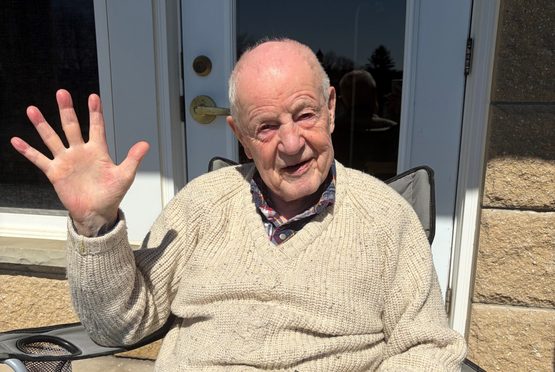 Instead, it became an early life lesson in humiliation.
George remembers working on a watercolour painting when his teacher picked up his work, walked to the front of the classroom and held it up for everyone to see.
“She said, ‘I want to show you some of the things not to do.’”
At 14 years old, he was devastated.
“I swore, at that moment, I’d never do another picture as long as I live.”
Now, at 94 years old, the resident of The Village of Arbour Trails paints almost every day.
His life story is filled with moments where people underestimated him and moments where he quietly proved them wrong.
After beginning university in physical education, George realized it was not the right fit. He switched to English literature, only to have the department chair try to discourage him from pursuing honours studies.
“He looked at me and said, ‘No, you don’t,’” George recalled.
Eventually, he was pushed toward philosophy as a second subject, despite admitting he had “not the foggiest notion” what philosophy actually was.
One professor saw potential in him immediately.
“He said, ‘You’ll make a good philosopher.’”
George eventually taught philosophy at the University of Guelph, specializing in philosophy of art. Ironically, despite teaching art philosophy, he still did not consider himself an artist.
His students often challenged him.
“They would ask, ‘What kind of art do you do?’”
Tired of not having an answer, George enrolled informally in a printmaking course taught by a friend in the fine arts department.
“I learned I liked doing it,” he said.
That curiosity became commitment. For the next 12 years, George painted and sketched from live models twice a week.
“I painted nudes,” he said with a grin. “Badly.”
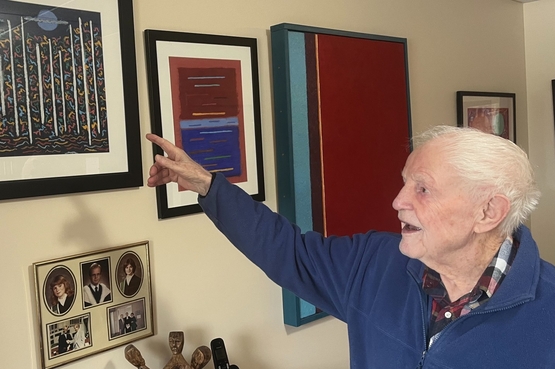 Still, he kept painting.
Art eventually became more than a hobby. It became a lifeline.
In his mid-50s, George began experiencing severe memory problems, something he attributes partly to multiple concussions earlier in life. While teaching philosophy, he found himself forgetting words and losing his train of thought during lectures.
“I was literally terrified,” he said.
At one point, he considered leaving academia entirely because he no longer believed he was capable of teaching.
“I had a very diminished self-respect.”
Then came an opportunity for early retirement. With the support of his wife, daughters and son, George stepped away from teaching at age 55.
“What am I going to do?” he remembered thinking.
The answer was art.
“I thought, ‘God, I’ve got to do something to preserve my self-respect,’” he said. “So what I decided to do was carry on making art.”
That decision changed the rest of his life.
“That was at 55,” George said. “I’m 94 now. Still doing it.”
Today, he speaks passionately about colour and composition, describing an instinctive ability to understand how colours belong together.
For someone once told publicly what not to do in art class, the irony is hard to miss.
When asked what he would say now to the teacher who embarrassed him all those years ago, George laughed.
“If she sort of insulted my abilities,” he said, “that’s what I’m going to do.”
And for nearly eight decades, that is exactly what he has done.


