
The people who come to live at Schlegel Villages are, in most cases, facing a major life transition and are often beset with obstacles they either place upon themselves or have had placed upon them by a society that still tends to medicalize the natural aging process.
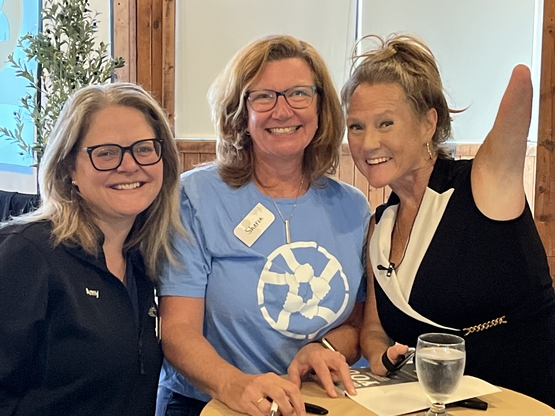 The first point of contact within the Villages is likely to be one of the Directors of Lifestyle Options (DLOs). In late May with the spring sun shining down on the Blue Mountain Inn near the shores of Georgian Bay, the small but mighty team of DLOs gathered to discuss how best to support new residents and loved ones seeking retirement living options in the Villages.
Joined by the Village Experience Coordinators (VECs), some Support Office team members and the retirement village General Managers and Assistant General Managers, they began the retreat with a keynote address by an inspiring woman who cast aside any misconceptions about societal limitations.
Tracy Schmitt was born without hands or legs, yet from the earliest of her days to every present moment, she continually shows people what is possible in life, regardless of ability or disability, seen or unseen. She races in sailing regattas the world over, climbs mountains, spreads kindness and carries a message of positivity and hope with her where she ventures
After her keynote, I had a chance to connect with Unstoppable Tracy Schmitt and ask what stood out to her about Schlegel Villages team members, many of whom care for older adults every day, including those living with dementia and Alzheimer’s disease.
“They were really warm, deep souls,” she said. “Not just polite or professional — real people, real hearts, real authenticity. I know that word gets overused, but that’s genuinely what I felt. It was magical.”
During her keynote, Tracy became emotional while speaking about her mother, who was her biggest and most ardent supporter, and lived with Alzheimer’s disease until her passing. She said the connection she felt with Schlegel Villages made her experiences with her mother over her life somehow more powerful.
“I think that’s partly why I was brought to tears seeing the picture of my mom,” she explained, “because I was surrounded by people who understand. There are so many people here who can relate through their own loved ones and life experiences. And then you realize these are the empathetic caregivers who give of themselves to others day in and day out.”
One phrase from the conference especially stayed with her: “We can do hard things,” which was a reflection presented by one of the DLOs, Sophia Heimpel from The Village at University Gates.
“I’ve done thousands of conferences,” Tracy said, “and I don’t think I’ve heard that phrase before in quite the same way, but when Sophia said it, you could feel how deeply it resonated with people in the room. Life is hard. Caregiving is hard. Supporting elders and families through difficult moments takes strength.”
The conversation turned toward assumptions people make about aging, disability and capability in a world that often dismisses older adults, or doesn’t seem to have the patience to understand their unique wisdom. Whether someone uses a mobility device, lives with a visible or invisible disability, or is simply older, Tracy said society often rushes to assume limitation before possibility.
When asked what advice she would offer caregivers, Tracy spoke of the importance of beginning with belief in a person’s abilities.
“Start by believing they can,” she said. “It’s kind when people ask, ‘Can I help you?’ but often that question reflects our own discomfort or assumption that someone needs help. People are adults. People get to decide.”
She encouraged caregivers to focus first on the person, not the perceived limitation.
“It would be so nice if people started with ‘Hello.’ Just hello. ‘Hi, I’m Tracy.’ Start with the human connection first.”
From there, she said, support becomes collaborative.
“If you really don’t know after that human connection, then ask: ‘Would you like a hand?’ And really listen to the answer.”
The discussion also touched on the idea of “learned helplessness,” particularly among older adults in care settings where constant assistance can slowly reduce a person’s confidence and independence.
“I wonder sometimes if people aren’t just looking for connection,” she said. “Maybe someone doesn’t actually need help getting their tea — maybe they want company, attention, interaction. Sometimes the only time people stop and engage is when they’re helping.”
That insight, she noted, reinforces the importance of relationships as the foundation of Village Life.
“People want to feel seen as people first,” she said.
For the DLOs and VECs charged with meeting people where they are and helping them navigate one of life’s major transitions, this is what they do every day. Whether a person comes to live at Schlegel Villages or takes a different path matters not, for they are always seen first and foremost.


