
At Schlegel Villages, innovation doesn’t only come from leadership tables or research papers. More often, it begins in the neighbourhoods in conversations between team members, observations made during care, and the willingness of people closest to residents to ask: “How can we make this better?”
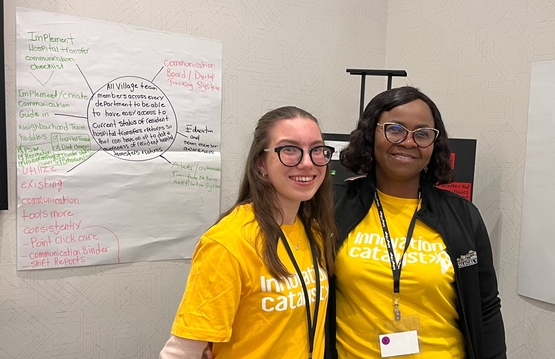 That spirit was on full display May 21 as a record 34 Innovation Catalysts representing 15 Villages gathered to continue their work on one important question: how can cross-functional communication in neighbourhoods be strengthened to improve outcomes for residents?
Guided by the principles of design thinking, these direct care team members from a wide range of roles have spent the past few months learning, listening, observing and gathering insights from fellow team members, residents and families. Rather than jumping straight to solutions, the process encourages catalysts to first deeply understand the challenges and experiences shaping daily life in the Village.
This year’s focus emerged from evidence showing communication plays a critical role in resident safety, team member experience and overall quality of care.
“Interdisciplinary communication is essential,” explained Jaimie Killingbeck, Assistant Vice President of Quality and Innovation during the spring Innovation Day, where the catalysts presented their initial findings and sought feedback from more than 150 people representing all walks of Village Life. “The evidence tells us that when communication breaks down, particularly during transitions and handoffs, it can impact resident outcomes, reporting, and even whether people feel safe speaking up.”
Research reviewed by the group highlighted that communication challenges often occur during shift changes, transfers to and from hospital, referrals and other high-risk moments. Just as importantly, the evidence reinforced the importance of psychological safety to ensure every team member feels heard and valued, especially those working most closely with residents.
“The neighbourhood team members often notice subtle changes first,” Jaimie said. “When people don’t feel listened to, important information can be lost. High-performing organizations create systems where every voice matters.”
For many catalysts, the process itself has been transformative.
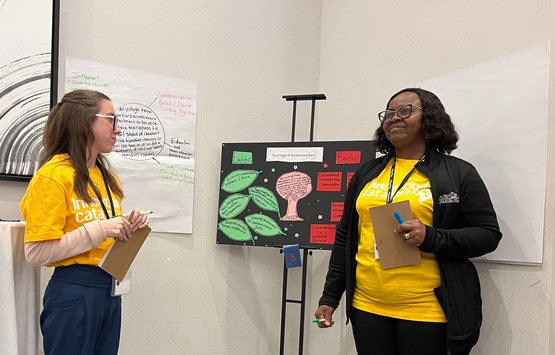 Amanda Stubbs from The Village of Sandalwood Park said she joined the initiative because she wanted to help address challenges she was seeing in daily Village life.
“Seeing all of the challenges and hearing all of the challenges, I really wanted to give my opinions and see how I could help,” she said.
Fellow Sandalwood Park catalyst Praise Appiah said the opportunity aligned with her desire to make a meaningful impact wherever she works.
“In every organization, there are challenges,” she explained. “If you are able to provide some solutions, it goes a long way to help.”
Both admitted the design-thinking approach was initially unfamiliar. Like many people, they were used to immediately trying to solve problems rather than slowing down to better understand them first.
“It was really interesting because I didn’t know this framework before,” Amanda said. “I didn’t realize how structured it could be.”
For Praise, the experience has opened doors to new perspectives and connections across her Village and Schlegel Villages as a whole.
“Meeting new people and hearing new ideas has been a real opportunity for me,” she said. “There is always so much Villages can learn from each other.”
The catalysts will continue refining their ideas over the coming months before presenting their work at the Innovation Summit this fall, carrying forward Schlegel Villages’ aspiration to connect research and innovation directly to Village life, one conversation at a time.


