
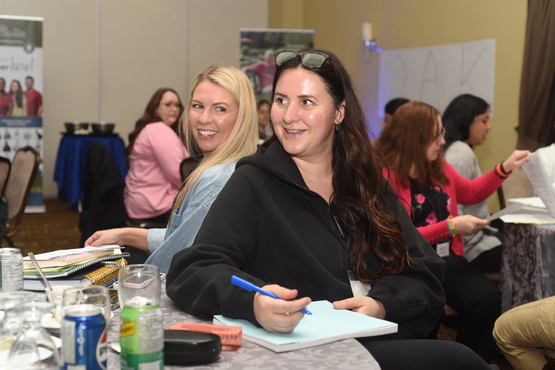
There are moments in every Schlegel Villages Leadership Retreat that make it feel far less like a conference, and more like a large family reunion.
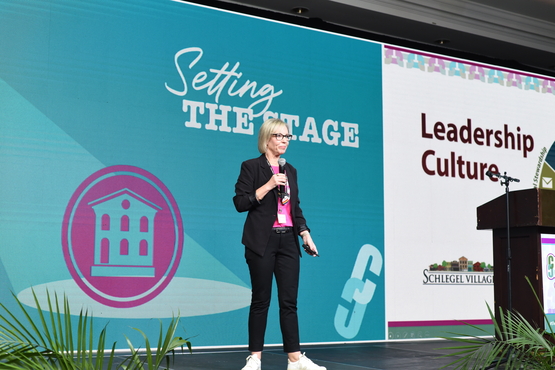
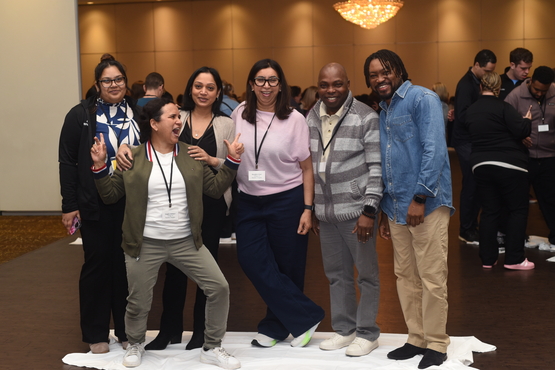 As Vice President of People Christy Parsons welcomed leaders from across the organization, she captured it with warmth and clarity: this is a time to come together as “keepers of the culture,” she said.
It’s a phrase that carries weight with the hundreds of leaders who once again gathered this spring to hone their leadership practices.
At Schlegel Villages, culture isn’t a slogan or a set of words on a wall. It’s something lived, protected, and passed on. As Christy reminded the room, a keeper of the culture is someone entrusted with preserving something valuable; in this case, that’s the family-centred approach that defines life in the Villages.
But culture doesn’t sustain itself.
“It has to be created. It has to be nurtured. It has to be led,” she said.
That leadership begins with a simple equation: culture equals values plus behaviours. When the two align, something powerful happens. Teams feel safe, people feel they belong and relationships deepen.
 It’s what filmmaker Sarah Fodey recently described after spending a vast amount of time with Schlegel Villages while filming The Green Bench, a documentary about Village residents travelling back to important places from their past.
“You’re all magic disguised as humans,” Sarah told Christy in conversation.
The line drew smiles, as Christy related the story, but it also landed as truth, because that “magic” isn’t by mistake. It’s the result of leaders who model the values every day, shaping environments where people can show up as themselves and feel that they belong.
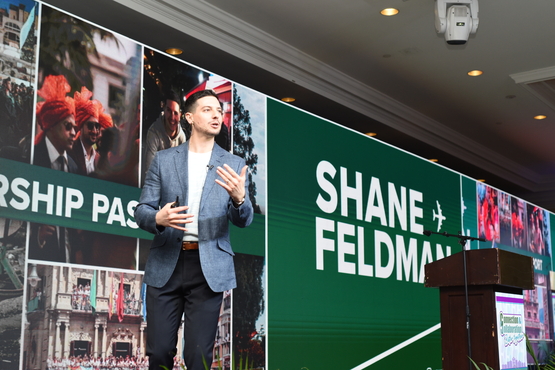
That idea of intentional culture-building carried into the keynote address from leadership expert Shane Feldman, who brought a global perspective to a deeply human challenge: how to turn ordinary teams into extraordinary communities.
Drawing from his travels across more than 100 cities, Feldman shared stories that all pointed to one central truth: belonging doesn’t happen by accident. It is designed.
 In Vietnam, he noticed that people rarely gather in closed circles. Instead, they stand in half-circles, leaving space for others to join.
It became a powerful metaphor.
In workplaces, circles often close – teams become insular, conversations harder to enter. Great leaders do the opposite, however; they create space, they invite others in, and they focus on inclusion.
Sometimes, that looks like something small.
It can be a thoughtful check-in, a moment of curiosity or simply a gesture that shows someone they’re seen.
Feldman calls these “Plus- 1 moments” – tiny, often unnoticed actions that build connection over time. On their own, they may seem insignificant, but together, they shape culture.
Connection, he emphasized, isn’t just built through what we say, but in how we show up.
In China, he observed large groups gathering daily in public squares, moving together in a shared rhythm. The lesson wasn’t about dancing but about connection through experience.
When people engage side by side – walking, moving, sharing space — conversations flow more naturally. Creativity increases. Trust builds.
For leaders, it’s a reminder that meaningful connection doesn’t always happen across a desk. Sometimes, it happens in motion, in shared moments that make relationships feel human.
Perhaps the most powerful lesson came from South Africa, where Feldman was introduced to a traditional greeting with an elder in a remote community.
“I see you,” the elder said upon greeting Feldman, not before a long silence had been carried between them.
 The response: “I am here.”
In that exchange is a profound leadership truth: people fully show up when they feel truly seen.
It’s a call for leaders to shift their focus—not just to directing or managing, but to listening deep and being fully present, allowing space for silence and reflection.
For Feldman, working with Schlegel Villages revealed something rare: an organization where these ideas are already taking root.
“There’s a real sense of community by design,” he said, after he finished his address. “You can feel the value alignment.” In a sector where loneliness can be a major challenge, that matters.
Around the world, many cultures still centre care within multigenerational families. In Western society, much of that has been lost. What Schlegel Villages is building is in many ways, a return to that model – creating spaces where residents, families, and team members are deeply connected.
“It’s the antidote to loneliness,” Feldman noted.
As the retreat unfolded, the message was clear.
Leadership here is not just about strategy or outcomes. It’s about people.
It’s about creating environments where others feel they belong. It’s about strengthening relationships through everyday moments. It’s about showing up with curiosity, presence, and care.
Because the “magic” is built, moment by moment, interaction by interaction, by leaders who understand that culture lives in what we do every day.
In that way, being a keeper of the culture isn’t just a responsibility. It’s a privilege.


