
Across Schlegel Villages, care and connection rarely happens in isolation. It happens in the hallways of neighbourhoods, in quiet check-ins along Main Street or in moments when a team member notices a need and steps in, regardless of their job title. This February, as Villages launch a dedicated focus on the aspiration to Promote Cross-Functional Teams, the fact that every team member plays an important role in every aspect of resident and Village life is reaffirmed.
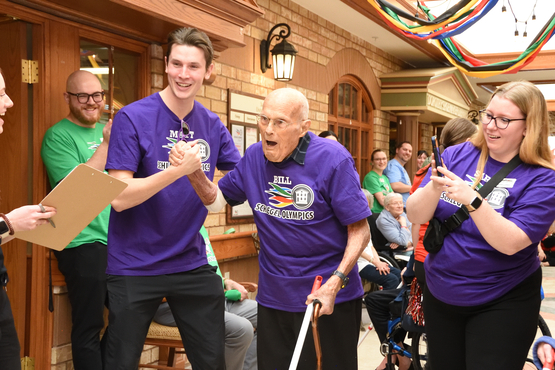 In recent conversations with Success Award winners from two Villages – Winston Park and Hamilton Continuing Care (HCC) – a shared story emerges where teamwork isn’t assigned or scheduled, but lived.
At Hamilton Continuing Care, Personal Support Worker Jeanette Tubongbanua describes cross-functional collaboration as something that feels almost invisible because it’s so natural.
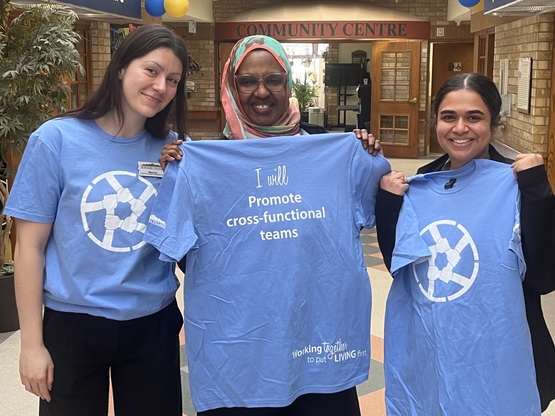 “You don’t have to work to be cross-functional because it’s kind of already happening,” she says. “Everybody here is like, ‘Are you okay today?’ It’s sort of natural here.”
In a truly cross-functional space, people don’t experience one another in siloed departments, which has often been the dominant arrangement in most healthcare settings. Instead, they experience one another as teammates. Housekeeping, food services, and the nurses and PSWs shouldn’t operate in isolation from each other but instead should move together, connected by shared responsibility for the support of residents’ well-being.
That sense of pride shows up at Winston Park when team members speak about the part they play in the collective support of residents. Ajay Dabola, a Personal Care Aide in the Emma’s neighbourhood in Retirement, describes how trust is built among team members and residents because of a commitment to ‘follow-through.’
“When you say you’ll do something, you have to do it,” Ajay shares. “That’s how trust is built.”
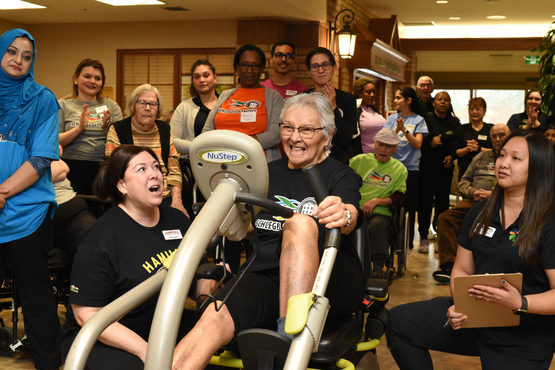 But follow-through doesn’t belong to one role. It belongs to the team. When someone is stretched thin, others step in, not because it’s written in a job description, but because it’s the right thing to do.
“When one person is struggling, the team steps in,” Ajay says. “That’s how care should work.”
Natasha Busacay, who has worked in multiple roles at HCC — from care partner to PSW to RPN — names this reality clearly.
“If someone needs help and you’re available, you help, whether you’re a nurse or a PSW,” she says. “If this person needs help and no one is helping them, and you are available, then you help.”
The key to success in the pursuit of this aspiration is communication; the quiet, everyday conversations that make cross-functional teamwork possible.
“Communication is the most important thing,” Natasha says, “and consistency.”
Strong teams are built when asking for help is normalized, when feedback is safe, and when communication flows freely across roles without traditional hierarchy getting in the way.
As Schlegel Villages grows, team members are clear about what must be protected.
“They said it might be different in a bigger home,” Jeanette reflects, considering Hamilton Continuing Care’s eventual move to The Village of Fennell Ridge, where construction is expected to be completed by in early 2028, “but culture is culture.”
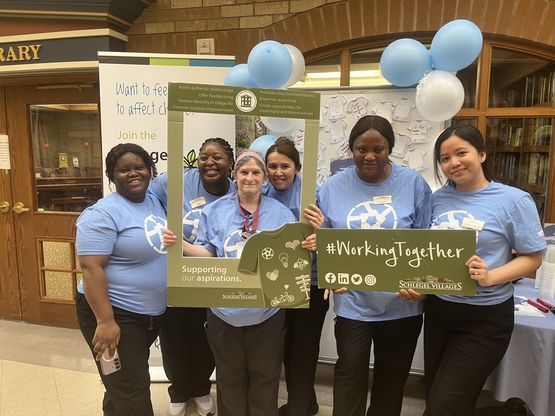 Scaling cross-functional teamwork doesn’t mean losing what makes it work, however. It means being intentional about preserving consistency, familiar relationships, and shared expectations around helping beyond job titles.
Across Winston Park and Hamilton Continuing Care, the message is consistent: cross-functional teamwork isn’t an initiative. It’s a mindset. It’s what happens when people see themselves as part of something bigger than their role and when residents are at the centre of every decision.
This February, as Schlegel Villages focuses on strengthening cross-functional teams, teams aren’t starting from scratch; they’re building on what already works, because when every team member works together to put living first, everyone belongs and everyone matters.


